Type Design I
DSD-3611-F
209 E 23 St, Room 304
September 05, 2017–
December 12, 2017
Tuesday 03:20PM – 06:10PM
Assignment 01
Oblique Strategies Poster
Oftentimes graphic design is reduced to the visual. A viewer encounters a piece of ephemera with a common set of pre-conceived notions in history, culture and their own semiotic view of the world. S/he has to internalize the visual based in-part (mostly) on the formal aspects they see and in what context it’s viewed. Unbeknownst to the passerby, the designer has followed multiple paths of decisions that lead them to their final solution.
The point is, the designers process is hidden when the project is delivered, the ink has dried, the code is rendered by the browser… these paths they’ve traveled lay on the cutting room floor. The classroom is different. We have a unique opportunity to discuss the why just as much as the what. This discussion will help shape what ‘design’ is to you. As you continue your practice you will learn, challenge yourself, change your mind, and develop your process.
In our first class you will draw a card from the deck of Oblique Strategies. You are to use this card as a prompt to design a type–only 18x24 in. poster.
In addition to your full size poster you must bring in 20 sketches that visualize your process. These could be (but not necessarily have to be) drawings of different concepts, quick explorations done on the computer of the same concept, a documentation of the poster in different forms before your final composition was realized, etc. Present these as a stack of 20 8.5x11 in. sketches/print outs. While working through your process, take the cards advice into account. How can it lead you to unexpected places? Use other cards as inspiration as well.
Craft is a critical component to this assignment. If you decide to tile your poster it should be perfectly constructed, with no tape, seams or adhering methods visible. If your poster is not perfect it will be passed over during our crit. Take pride in your work and display it properly. Hang it with clear thumbtacks and make sure it’s straight and orderly.
Be ready to present your poster with a rationale for the typeface you’ve chosen and an explanation of your concept.
Deliverables
1Final, full size poster
18x24 in
20Sketches
8.5x11 in
Background
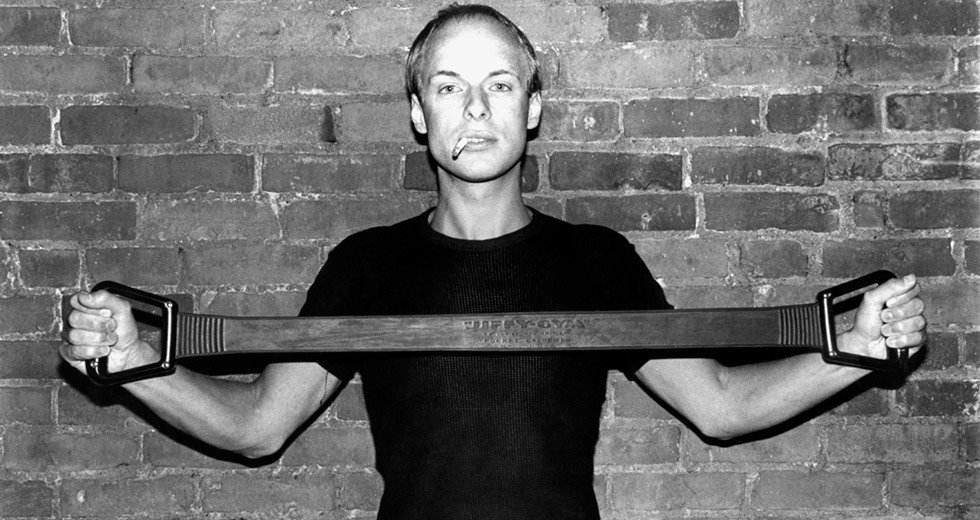
In 1975 artists & musicians Brian Eno and Peter Schmidt collaborated on a project titled Oblique Strategies. Inspired by the readings of I Ching, the two published a set of cards used to generate ideas and break routine thinking patterns.
While born out of a studio context, Oblique Strategies translated equally well to the music studio. For Eno, the instructions provided an antidote in high-pressure situations in which impulse might lead one to default quickly to a proven solution rather than continue to explore untested possibilities: “Oblique Strategies evolved from me being in a number of working situations when the panic of the situation—Particularly in studios—tended to make me quickly forget that there were others ways of working and that there were tangential ways of attacking problems that were in many senses more interesting than the direct head-on approach.”
—Brian Eno: Visual Music, Christopher Scoates
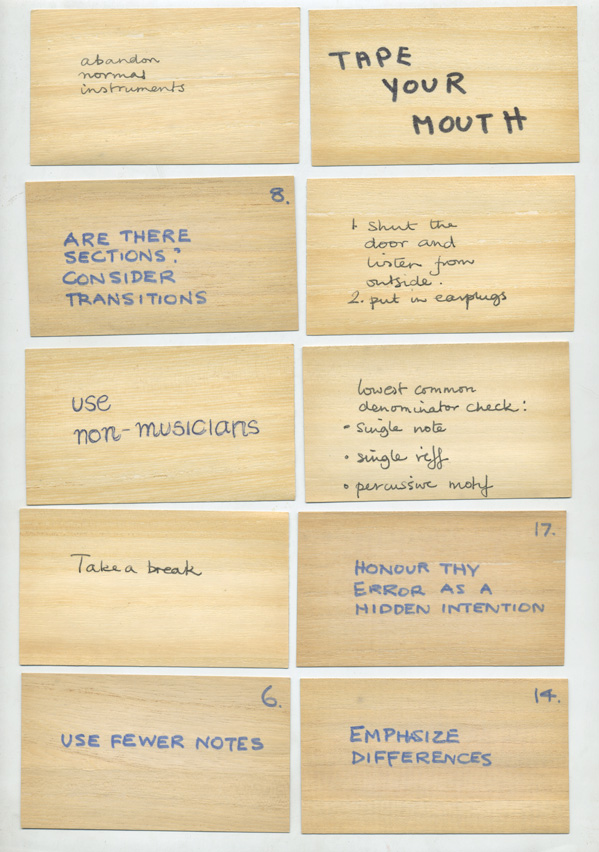
Now on their fifth edition, Oblique Strategies have been published in English, French and Japanese. Each edition changes slightly, adding or removing different cards. If you're interested in learning more, Gregory Taylor has put together a fine website documenting the editions and pulling together some more information about the deck.