Type Design II
DSD-3612-C
January 10, 2017–April 25, 2017
Tuesday 03:00PM–05:50PM
209 E 23 St, Room 506
Assignment 05
Punctuation
Choosing the typeface you analyzed in week 6, create a new form of punctuation and draw your character for that typeface.
Punctuation is key to creating flow and understanding an authors intention in a piece of text. It can communicate the ending of a sentence (.), a pause(—), excitement (!), a question (?), etc. Determine what's missing from our alphabet and communications methods and define the rules around it. Show the piece of punctuation in a sentence. You are not making emojis. Consider the form your punctuation takes and how it connects to the meaning you've prescribed to it.
When drawing your character bring your analysis of form from your chosen typeface into the marking. Make sure it feels consistent to the rest of the letters.
Deliverables
1. Print your character as large as possible, portrait or landscape (whichever makes most sense) 11x17
2. Print a sentence with the punctuation in use, landscape 18x24
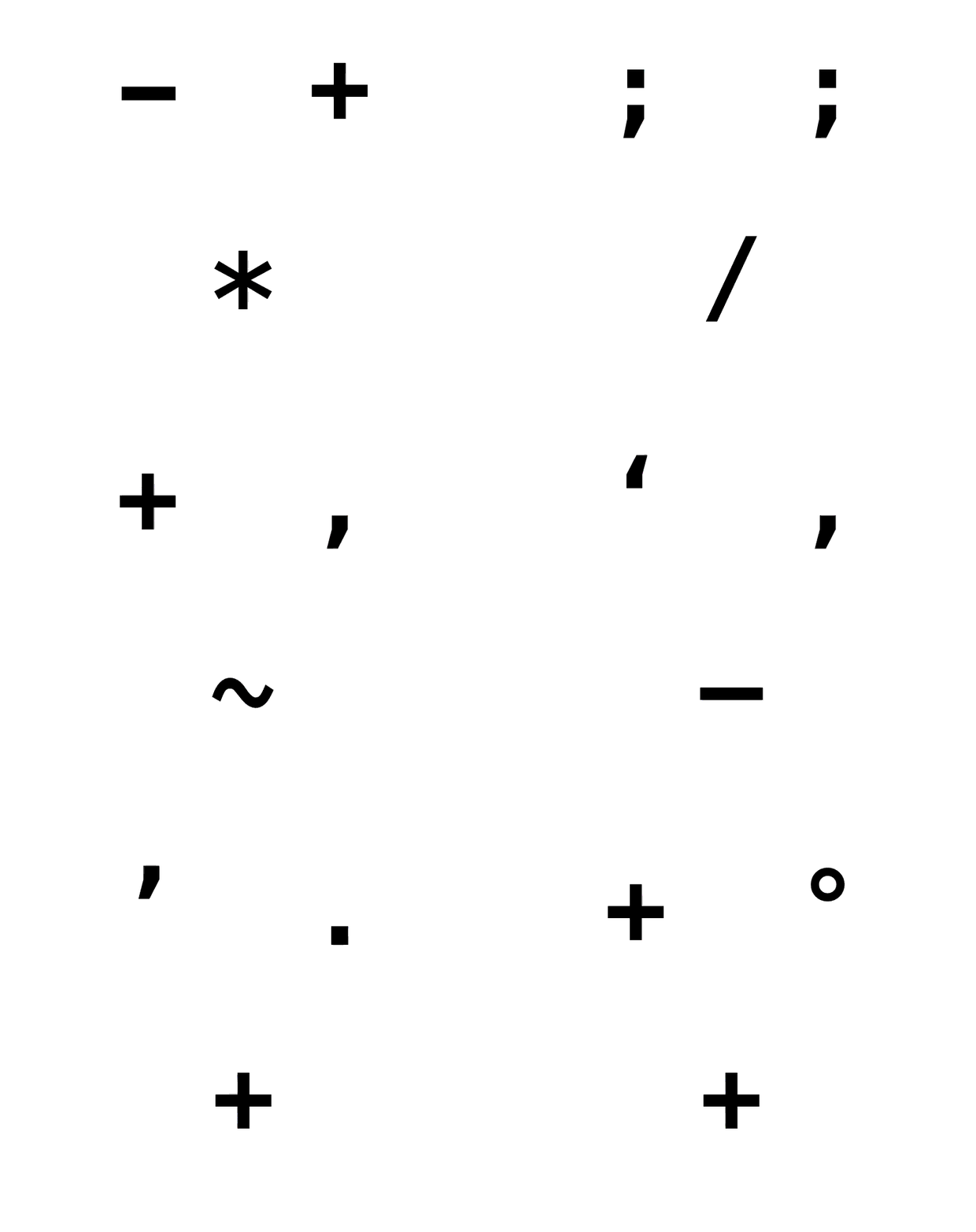
3. Print a specimen of your typefaces letters and key punctuation with your new mark added, portrait 24x36. Include the uppercase and lowercase letters. Lay out your punctuation like so (let the lines rag) and make the letters as large as possible —
ABCDEFGHIJKLMNOPQRSTUVWXYZ
abcdefghijklmnopqrstuvwxyz
1234567890$&.,—;:?!‘’()
4. Print the description of your rules, landscape 11x17. An example —
Full stop (British), or Period (American)
The full stop or period ( . ) is firstly used to mark the end of a sentence. It is also used to mark abbreviation of names as initials.
Background
Punctuation is the use of spacing, conventional signs, and certain typographical devices as aids to the understanding and the correct reading, both silently and aloud, of handwritten and printed texts. Another description is: "The practice, action, or system of inserting points or other small marks into texts, in order to aid interpretation; division of text into sentences, clauses, etc., by means of such marks."
In written English, punctuation is vital to disambiguate the meaning of sentences. For example: "woman, without her man, is nothing" (emphasizing the importance of men), and "woman: without her, man is nothing" (emphasizing the importance of women) have very different meanings; as do "eats shoots and leaves" (which means the subject consumes plant growths) and "eats, shoots, and leaves" (which means the subject eats first, then fires a weapon, and then leaves the scene).[3] The sharp differences in meaning are produced by the simple differences in punctuation within the example pairs, especially the latter.
The rules of punctuation vary with language, location, register and time and are constantly evolving. Certain aspects of punctuation are stylistic and are thus the author's (or editor's) choice, or tachygraphic language forms, such as those used in online chat and text messages.
Wikipedia
List of English Punctuation